
Saturday, November 20, 2021
Weather, Waves and Water – The New South Wales Central Coast
This book fills a much-needed void in providing a specialist description of the meteorology of the New South Wales Central Coast.
This is an area that has progressed enormously over the past decade, and has now become a major social and tourist hub, strategically located between Sydney and Newcastle.
Fishing, boating and tourism are of major importance in the area, to both locals and to the increasingly large population of Sydneysiders who have made the Central Coast a prime holiday location.
All these activities are highly weather sensitive so a discussion of the unique local meteorology of the area seems timely. Told through the turbulent story of east coast lows, shipwrecks, thunderstorms, southerly busters, floods, dust storms and bushfires, the author, Richard Whitaker, provides a focussed insight to the “Weather, Waves and Water “ of the New South Wales Central Coast. Progress in the prediction of all these types of weather events is also discussed.
Richard Whitaker has been a meteorologist for more than 50 years, and has written numerous publications about the weather. He is an active local community lecturer, delivering talks about meteorology to such groups as Probus, Rotary, Libraries, U3A, bushfire brigades, historical societies, schools and business groups.
He served with the Bureau of Meteorology from 1971 to 2002, and then became Chief Meteorologist with the Weather Channel and Sky News Weather from 2004 to 2016. Today he lives at Terrigal on the Central Coast with his wife of 52 years. They have two children and five grandchildren.
Contact:
weathersmart047@gmail.com
“Weather Waves and Water – The New South Wales Central Coast” can be ordered through the email above for a price of $34.00 – including postage.
 Image: The wreck of the “Cawarra”, Newcastle Harbour, 12th July 1866
(http:trove.nla.gov.au/version/182163475:Woodcut by Frederick Grosse)
,
Image: The wreck of the “Cawarra”, Newcastle Harbour, 12th July 1866
(http:trove.nla.gov.au/version/182163475:Woodcut by Frederick Grosse)
,

Friday, October 8, 2021
Australia's Natural Disasters
By Richard "Dick" Whitaker

On Christmas Eve 1974 Darwin pubs were bursting with festive people joking that ‘cyclones never hit Darwin’. Cyclone Tracy was expected to be another ‘near miss’. But in the early hours of Christmas Day the slow-moving tropical cyclone tore the city apart, with sustained winds of 200 kilometres per hour, and Darwin became another victim of nature.
Cyclone Tracy is only one of the many extreme weather events that Australia has been subjected to. Australia’s Natural Disasters tells many stories of the devastation nature has wreaked on our wild country. From the agonies of droughts and floods to the shock occurrence of earthquakes and bushfires, Australia is a country famed as much for its ferocious natural hazards as it is for its rich environment. Freak weather has caused plane crashes and shipwrecks and even been blamed for the disappearance of a Prime Minister.
Australia’s Natural Disasters is a fascinating chronicle of the ferocity of nature and the dramatic effects it has had on this country and its people – from the mid-1800s to the seemingly more frequent extreme-weather events of the 2000s.
It is also a story of great progress both in weather prediction, as led by the Bureau of Meteorology - and in disaster recovery, from the work done by the various State Emergency Services and Rural Fire authorities. Australia now has a world-class system for dealing with natural disasters from early prediction to the aftermath.
Disasters covered include the bushfires of 2019 and 2020, Cyclone Yasi and Cyclone Tracy, The Black Saturday 2009 Bushfires and the devastation along with the Queensland Floods and the 2021 Floods, the Sydney to Hobart Yacht Race, the mass rescue at Bondi Beach, Dust Storms of 2009 and the devastating hail storm that struck Sydney's East and much more.
All this illustrated by on-the-spot photos of Australia’s natural disasters and their consequences.
Recent publications by the author:
From Gods to Gigabytes – a Brief History of Weather Forecasting
Firewise, Firesafe - How to Survive a Bushfire
For information about either publication you can contact the author at
weathersmart047@gmail.com
Tuesday, July 20, 2021
The 1930 Melbourne Cup - Phar Lap and the Weather
The date was Tuesday 4th November 1930 and the existing photographs of the day show sunshine, a crowd in hats and coats, no umbrellas and no sign of windy conditions.

Phar Lap wins the 1930 Melbourne Cup. The image clearly shows shadows created by individuals in the crowd, indicating sunshine at race time.(State Library of Victoria)

"The synoptic chart on 3rd November shows a strong cold front near Adelaide with the close packed isobars a feature over south-eastern parts of South Australia and western Victoria.
The accompanying Bureau “Notes on the Chart” were instructive:
“The rapid development of a deep atmospheric depression in the eastern Bight was the outstanding feature of Monday morning’s weather. As shown by the isobaric chart the foremost half of this depression was receiving a strong flow of northerly winds from the inland areas of eastern Australia. During the day the centre of the depression moved to the eastern entrance to Bass Strait and also deepened considerably, this intensification of the disturbance being attended by northerly winds of almost gale force at many places in Victoria. Dust storms were plentiful inland and in Melbourne the dust was much in evidence, first in the coppery hue of the sky during the afternoon and later in fierce dust squalls after 7 pm, the wind reaching 44 miles an hour. Shortly after a light fall of “red” rain occurred in the city. At 9 pm the wind changed to a cool westerly, temperatures fell 10 degrees almost at once and the showers recommenced”.
The Bureau records show that the maximum temperature in Melbourne on Monday 3rd November was 31.3C and the next day, Melbourne Cup day, was only 17.7C. Rainfall for the 24 hours at 9 am on Cup Day was 3.6 mm and over the next 24 hours 2.5 mm was recorded.
From the photographic evidence it looks as though the weather had cleared for the Cup – but the timing appeared to be a close thing.

Phar Lap is Thai for “sky flash” or lightning, and the horse that was runner up was “Second Wind”.
Recent publications by the author:
From Gods to Gigabytes – a Brief History of Weather Forecasting
Firewise, Firesafe - How to Survive a Bushfire
For information about either publication you can contact the author at
weathersmart047@gmail.com
Wednesday, June 23, 2021
The Siege of Glenrowan: Ned Kelly's Last Stand

The Back Story
On the early morning of Monday 28th June 1880 a party of police confronted the Australian outlaw Ned Kelly and his gang, who were holed up in the Glenrowan Inn, located in northeastern Victoria.
Just before dawn police opened fire on the gang as they stepped out onto the veranda of the Inn and the two groups exchanged gunfire for an extended period. The events that followed are now part of Australian folklore, with Ned emerging from the half light of the dawn dressed in armour plate and attacking the police.

Ned Kelly, in full armour, attacks the police (Wikipedia Commons)
He was eventually captured and the other gang members (Dan Kelly, Steve Hart and Joe Byrne) were killed.
One feature of the siege is seldom discussed - that of the weather. However by using available resources from the Bureau of Meteorology data base, contemporary photography, lunar tables and existing newspaper reports we can construct a reasonable estimate of the weather conditions on the morning of 28th June 1880.
Available weather data
Rainfall:
Glenrowan lies between two much larger rural settlements - recognised as cities today - but much smaller back in 1880. Wangaratta is about 14 km to the northeast of Glenrowan, and Benalla 30 km to the southwest.
Weather observations did not commence at Benalla until 1882 - some two years after the siege. But fortunately records go back to 1868 at Wangaratta, with daily rainfall totals recorded all through until 1987 - a virtually unbroken period close to 120 years. This covered all of 1880, including of course, the day of the siege.
Temperature:
Temperatures are a more difficult issue. Rainfall data was taken from many rural locations during the 19th Century but temperature data is less common. The reasons for this are various but basically thermometers were harder to come by and more expensive to purchase than the simple rain gauge.
As far as the Glenrowan siege is concerned no temperature data was
available in the immediate area but some ideas can be obtained from
contemporary newspaper reports. The event was big news and reporters from
major newspapers were sent to Glenrowan in the early morning of June 28.
They rode on a special train that carried a police contingent tasked with
confronting and subduing the gang.
The reporters were Joseph Melvin of the Argus, George Allen of the Melbourne Daily Telegraph, John McWhirter of The Age and Francis Carrington of the Australasian Sketcher. They boarded the police train at Spencer Street Station late on Sunday night, 27th June 1880.
Newspaper Reports:
Francis Carrington later recalled that "the great speed we were going at caused the carriage to oscillate very violently. The night was intensely cold".
John McWhirter of the Age also described the scene: "The night was a splendid one, the moon shining with unusual brightness whilst the sharp frosty air caused the slightest noise in the forest beyond to be distinctly heard".
An article also appeared in the Freeman's Journal, Saturday 3rd July 1880- likely written by one of the reporters on the police train: "The night was clear and cold, the sky being almost unclouded. It was a pleasant night despite the sharpness of the temperature for the air was crisp and bracing and the sky was thickly studded with myriads of stars".
Upon reaching Benalla railway station the reporter again remarked on the night sky: "A fine large station but dimly lighted by gas. That mattered little though for by this time the moon was up, silvering with her radiance the earth and the heavens and casting a halo of glory upon the rugged and mountainous "Kelly country" - the peaks and spurs of which reared themselves ahead of us - standing out in bold relief against the cloudless sky".
These reports clearly indicate that the early morning of 28th June was clear and cold, with local frosts likely around the Glenrowan area. Lunar tables indicate that the moon was in the "waning gibbous" phase - the first phase after full moon.
Francis Carrington also produced this sketch showing the reporters huddled together in the train carriage - again hinting at the very cold temperatures of the early morning, 28th June 1880. (State Library of Victoria)

The daily rainfall record for Wangaratta for June 1880 reveals a wet spell
before the siege. In the 24 hours ending at 9 am on 25th June 26.9 mm was
recorded followed by 13.2 mm the next day. This was on top of 105.8 mm in
April and 44.2 mm in May, meaning that it was likely that conditions in the
bush in the surrounding area, including Glenrowan, were wet under foot on
the morning of the siege.
Also, in "A Guide to Australian Bushranging - the Siege of Glenrowan Part
2", the author mentions that
"Shortly after heading into the bush Ned passed out near a fallen tree.
It is uncertain how long he was unconscious for but when he came to he
crawled into the bush leaving his carbine and skull cap behind in the
mud".
This would indicate that there were likely puddles and mud areas around the
Glenrowan Inn, due mainly to the rain event of the previous week.
Wind
There were no formal wind recordings taken from the immediate area. However
during the early afternoon the Glenrowan Inn was set on fire to displace any
gang members that may have still been inside. Photographs of the burning Inn
were taken and the line taken by the pall of smoke gives us some idea on the
wind direction at the time.

Visibility
There are several newspaper references to "mist" around the Glenrowan area
in the early hours of of 28th June, mostly around the time that Ned Kelly,
in full armour, attacked the police from outside the Inn.
A retrospective article in the Ararat Advertiser of 26th February 1914
recalled that
"...when on the tragic morning Kelly loomed out of the mist in his armour
and bullets began to fly..."
In summary:
The weather conditions during the famous siege of Glenrowan that occurred
from the early hours of 28th June 1880 until well into the afternoon have
been reconstructed using data from the Bureau of Meteorology, contemporary
photography, the lunar calendar and newspaper reports from the time.
From this information it is hypothesised that the pre-dawn conditions were
clear, cold and frosty, with the ground wet underfoot as a result of quite
substantial rain over the previous week. Some morning mist also lay
across the area. As the day progressed some cloud moved across but no rain
fell.
Wind during the afternoon was likely from the west to southwest as deduced
from the direction of the smoke plume produced when the Glenrowan Inn was
set on fire by the police.

Tuesday, January 5, 2021
Hermit of the Murray River – “The Possum”
One of the most intriguing stories of the Australian bush is that of David James Jones – better known as “The Possum” who lived as a recluse along the Murray River for more than 50 years.


The rainfall decile chart for 1982. For parts of Victoria it was the driest year on record. (Courtesy of the Bureau of Meteorology)

He lived outdoors for nearly all this time, travelling between several bush hideaways along the river and shunning nearly all human contact. From around 1928 until his death in 1982 he was almost a complete hermit, seldom conversing with anyone but presenting as a gentle eccentric who loved animals and performed anonymous acts of kindness to farmers in the area. These included fixing broken fences and crutching flyblown sheep, usually working at night while the farmers and their families slept.
From what is known of his earlier life, he was a New Zealand shearer who arrived in Australia around 1928 but could not find work in the local area around Wentworth. His solution to this problem was to walk away from society and he “went bush” - staying there for the rest of his life.
He lived off the land by fishing and trapping small game such as wallabies and foxes and dressed himself with discarded clothing left out for him by various station owners in the area. He lived in the wild, beautiful and primeval landscape along the Murray and Darling Rivers, particularly around the Wentworth and Renmark areas, constantly on the move between a series of hidden camps he set up along the way.
He travelled a lot at night, sometimes covering up to 50 kilometres at a stretch, always avoiding any townships in the area. He often swam back and forth across the Murray River, both to change camps and to avoid human contact. He reportedly slept in trees on occasion, leading to his nickname “The Possum”.
He had to endure the full gamut of Australian weather - blazing temperatures in summer, freezing conditions in winter, and all the floods, droughts and dust-storms that are all part of the climate of the area.
In particular he had to negotiate the massive Murray River floods of 1956 when widespread inundation affected much of “Possum Country”, including Mannum, Mildura, Renmark and Wentworth.

Flooding around Wentworth Hospital, 1956
(Courtesy of the Sunraysia Daily)
From the late 1970’s those who new of him became increasingly concerned for his welfare, as it became inevitable that his advancing age would collide with his primitive lifestyle.
And that day arrived in 1982 when his body was found, alone in the bush, by two woodcutters near Ned’s Corner Station (about 70 km west of Mildura) on 4th August. It was estimated that he had died some three weeks before, about mid to late July. He was 81 years of age.

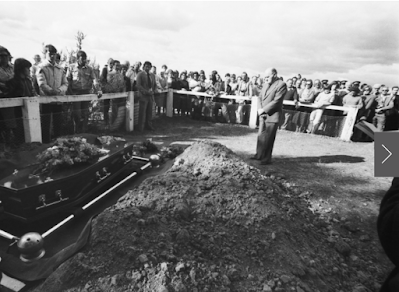
Possum’s” funeral was held at nearby Wangumma Cemetery, close to his beloved Murray River and was attended by a large crowd of locals.
(Courtesy of the Sunraysia Daily)
On his simple tombstone is engraved:
David James Jones
“Possum”
1901-1982
At rest where he roamed
Living to that age under the harsh circumstances of his everyday life was quite remarkable. However it may have been more than old age that finally caused his death - the weather may well have been a factor.
For 1982 was an infamous year in the meteorological history of Australia. It saw the combined and in-phase influence of four major climate phenomena – El Nino, Indian Ocean Dipole, Inter-Decadal Pacific Oscillation and Southern Annular Mode.
Verdon-Kidd and Kiem (*) noted that in 1982 “all four modes were locked into their dry phase” resulting in one of the most intense droughts in Australia’s recorded history. This would eventually lead into the devastating Ash Wednesday bushfires of February 1983.

In times of drought clear skies are more frequent than normal and during the winter months over inland areas this means plummeting overnight temperatures and a direct consequence – that of frost - often follows.
June and July 1982 were exceptionally cold months along the Murray River, as revealed by the temperature record from the Bureau of Meteorology’s weather station at Mildura Airport (AP). This station opened up in 1946, replacing the old site at the Mildura Post Office that operated between 1889 and 1949. The AP station has taken continuous records ever since, including rainfall, temperature, humidity and wind data. It is likely “The Possum” saw aircraft taking off and landing from the airport as he passed by along the Murray River, about 8 km to the north.
The mean minimum temperature for June 1982 at Mildura AP was 2.2C, still the coldest June on record there. For July it was only 1.5C – the coldest July on record and indeed the coldest of any month so far recorded at Mildura AP.
In June below zero minimum temperatures were reported on nine occasions and in July, seven. There were many cold frosty mornings across the general area during this time.
On the 21st July the mercury fell to minus 4.0C – the coldest temperature ever recorded at Mildura Airport.
It is possible, perhaps even likely, that this succession of extreme minima were too much for “The Possum”, and directly contributed to his death.

Today a life sized statue of “The Possum” stands at Fotherby Park, Wentworth, showing him in a characteristic pose - shielding his eyes as he looks across the Murray River and with a rope belt supporting his trousers.
(Image: R. N. Whitaker)
(*) Nature and causes of protracted droughts in southeast Australia:
Comparison between the Federation, WWII, and Big Dry droughts
Danielle C. Verdon-Kidd and Anthony S. Kiem
GEOPHYSICAL RESEARCH LETTERS, VOL. 36, 2009
2. Rainfall deciles for 1982 (Bureau of Meteorology)
Monday, August 17, 2020
From Gods to Gigabytes - A Brief History of Weather Forecasting
"From Gods to Gigabytes - A Brief History of Weather Forecasting" - is now available in book form. For more details, and to order, contact weathersmart047@gmail.com

The first “weathermen” were usually high priests, witchdoctors or medicine men, whose duties involved not only “foretelling” the weather but also ensuring that the Gods were placated so as to guarantee favourable conditions into the future.
The belief in the divine nature of weather continued across the millennia with hailstorms in mediaeval Europe, for example, sometimes being followed by the burning of witches.


Great Minds of Antiquity
However even in ancient societies inquisitive minds were at work to try and identify “natural” causes that drove the weather. Such great intellects as Hippocrates, Aristotle and Pliny the Elder all produced treatises on the subject, offering many ideas that were later shown to be incorrect but nevertheless demonstrating a desire to look beyond the supernatural.
Aristotle's treatise on th subject - Meteorologica - meaning a study of phenomena high in the air, was to give the modern science of meteorology its name.


Aristotle – believed that the weather was the result of natural forces rather than the moods of the Gods. (Image from Wikipedia Commons – click to enlarge)
Weather Folklore
Another source of progress in the “natural” understanding of weather came, not surprisingly, from the two main groups most intimately affected by it – farmers and mariners. Both noted correlations between the weather and cloud patterns, the nature of the wind and even changes in plant and wildlife behaviour.
The mariners, in particular, forged ahead steadily, and by the mid 1700’s sailing boat captains had gathered a good working knowledge of the main wind regimes of our planet, giving them nautical names that persist today, such as the Roaring Forties, the Trade Winds and Doldrums.

A formation of alto-cumulus - a "mackerel" sky.
"Mare's tails and mackerel scales make tall ships take in their sails." (Image from Wikipedia Commons – click to enlarge)
Whilst much of the “weather folklore” did not provide a lasting contribution to meteorology, it nevertheless formed a bridge between the Divine nature of weather and the Scientific Era that was to follow.
The Scientific Era
During the latter half of the Middle Ages, several exciting developments were made that would help catapult meteorology into the world of science, where it at once took root and flourished.
Instruments for measuring the state of the atmosphere were invented in the 15th, 16th and 17th centuries and were followed in quick time over the next 100 years by important discoveries on the chemical composition and temperature structure of the atmosphere.
During this time the hygrometer was invented by Leonardo da Vinci (1452 – 1519), the thermometer by Galileo Galilei, (1564 – 1642), and the barometer by Evangelista Torricelli (1608 – 1647).
Knowledge exploded during the 19th century with the discovery that large belts of high and low atmospheric pressure constantly circulated the globe, and the invention of the electric telegraph allowed this information to be transmitted faster than the pressure systems themselves, could move.


Samuel Morse (1791 – 1872) American inventor of the electric telegraph and the Morse code (Image from Wikipedia Commons – click to enlarge)
International cooperation in exchanging weather data was achieved in 1878 with the founding of the International Meteorological Organisation (IMO).
The 20th century saw progress accelerate at an astounding rate, with national meteorological services forming around the world and the beginnings of “weather forecasting by mathematics” off to a solid start, following pioneering work by the English scientist Lewis Fry Richardson.
The IMO evolved into the WMO - the World Meteorological Organisation in 1950, and soon attracted more than 170 member counties, all with the aim of generating and sharing weather information on a basis of global cooperation.
The first meteorological satellite was launched in 1960, and was accompanied by a steady increase in weather observing stations and radar installations right around the world.

The first photograph transmitted by TIROS 1 from space - 1960 (Image from Wikipedia Commons – click to enlarge)
Into The Future
By the beginning of the 21st Century meteorology had evolved into a vast, complex interdisciplinary science, with weather forecasts being produced out to seven days ahead by massive supercomputers linked to a vast international array of automatic weather stations, meteorological satellites and floating oceanic buoys.
Meteorology has become a glowing example of international cooperation with a developing science made available to all for the common good, sometimes within hostile political environments. If meteorologists ruled the world life could be rather dull but it would be peaceful.

New weather God - an SGI Altix supercomputer located in France is housed in a structure strangely reminiscent of a church (Image from Wikipedia Commons – click to enlarge)
The accuracy of weather forecasts has been steadily increasing, and with more computing power becoming available, together with an increasing density of meteorological observations, this increase is expected to continue well into the future.
The long march from Gods to gigabytes has been one of the epic journeys of humanity and provides a fascinating insight both into the weather and the almost infinite inventiveness of the human mind.
"From Gods to Gigabytes - A Brief History of Weather Forecasting" - is now available in book form. For more details, and to order, contact weathersmart047@gmail.com
Wednesday, January 31, 2018
The Brighton Tornados of 2 February 1918
In
the afternoon of 2nd February 1918, severe thunderstorm activity
associated with a low -pressure trough spawned a tornadic outbreak across Port
Phillip Bay. Two funnels moved
from the water across the shoreline around Brighton Beach at around 4.45 pm and
moved inland, producing widespread devastation across the surrounding area.
There
were also reports of a third funnel, although eyewitness accounts were somewhat
confusing because of the speed and complexity of the event.
Upon reaching the shoreline, the tornados unleashed their full fury across Brighton, where according to “The Age”, “hundreds of houses were unroofed, thousands of trees snapped or twisted in two, and fences levelled to the ground…. The damage done to property is computed at upwards of £100,000, and the “risk” was one of those not covered by insurance”.

The Methodist Church, 741 Hawthorn Road was largely wrecked
in the storm.
“The Argus” reported that :
The moment it struck the
mainland the air became thick with flying tiles, sheets
of galvanised iron, branches of
trees, and pieces of wood. The wonder of it is that more people were not injured.
Sheets of iron were flying through the air like birds, and there are
authenticated cases of heavy beams being carried more than 100 yards before
they fell to earth. Sheds were moved bodily. Chimneys fell through the roofs of
houses and in many cases the houses themselves proved unable to stand against
the terrific pressure of the wind and collapsed.
Tragically,
two people also lost their lives. At Point Ormond, three men were fishing from
a boat that was capsized, and Gordon McLeod, “a window dresser from Sydney”
drowned.
“The
Brighton Southern Cross” reported
Young Frank Green, 14, of Chetwynd Street, North Melbourne
was killed as a result of
the storm. He was with the ‘Sower’s Band Picnic’ at Brighton
Beach and left with a friend
to go for a swim in the baths. They reached a fruit stall on
the return journey at the height of the storm and the stall fell on the boy,
severing the top of his head..
One of
the tornados then continued inland, passing across Ormond, Garden Vale and
Oakleigh, before finally weakening. There is little doubt that the death and
damage toll would have been much higher in similar circumstances today, but
back in 1918, these areas were much more sparsely settled.

The “Daily Weather Chart” for 2nd February
1918 that appeared in “The Age” two days later.
The
following explanatory notes accompanied this chart:
“The
chief interest, however centres in the shallow cyclonic depression shown
immediately west of this State on Saturday morning. As this “low” drifted
eastward over the metropolitan area it produced the quiet stagnant condition of
the air conducive to the genesis of violent convectional currents and resulted
in the formation of waterspouts over Port Phillip, which reached the shore in
two points in Brighton, and travelled inland, apparently in violent tornadoes.”
The
Commonwealth Meteorologist, Mr. H. A. Hunt, issued a press statement which
noted that “the atmospheric disturbance
on Saturday was something in the nature of a tornado. …The disturbance, it was
thought, was the a marked intensification of an ordinary Antarctic storm, with
the thunder accompaniments and squalls……. The velocity must have been terrific
– stronger than ever I have experienced in Victoria or NSW…”.6
A
detailed report in “The Argus” on Monday 4th, included a map that
depicted two main funnels, and described their movement.
“The starting points are given as Brighton Beach and
Wellington Street, joining at Halifax Street, then swinging away to the
north-east, so that Landcox and Ormond, to the north, and Jasper road, to the east
are shown”.
This
description indicated that there were two funnels moving inland from the Bay
that appeared to amalgamate close to the intersection of Centre Road and
Halifax Street. This article, plus another written in “The Southern Cross”, on
9th February, indicated at least seven locations where
the damage was notable:
*
Brighton Beach Baths
* Corner
of Albert and Wellington Streets
* Landcox
Park
* Brighton
Cemetery – Adam Lindsay Gordon’s headstone blown over
* “Billilla”
- owned by the Weatherly family, 26 Halifax St
* Brighton
Beach Railway station
*
Methodist Church, 741 Hawthorn Road
These
locations, together with later reports of the damage trail indicate a likely
path taken by the funnels as shown here:

It was
later estimated that the twisters had produced wind gusts of around 320 kph,
and on the modern enhanced Fujita scale, this would correspond to a rating of
EF4.
George
Johnston, in his semi autobiographical book “My Brother Jack”, described the
scene from the nearby shoreline
“….from the little jetty we saw the great storm which
was to known as the Brighton Cyclone charging towards us across the bay in a
whip of white horses below a
tumult of bruised purplish crepuscular cloud. Coming across the sea, the cloud
would tear off in downward strips that would begin to gyrate madly, and scoop
the harbour waters high in the air”. 8
A
tornado relief fund was instituted soon after and was administered by the Mayor
of Brighton, Lieutenant-Colonel J.J. Hanby. Donations were acknowledged
publicly with the donors names printed in daily newspapers.
Subscribe to:
Posts (Atom)
